So, Are We Really Calling It “Super Intelligence” Now?
On September 29, the White House issued an executive order directing the executive branch to start using “Super Intelligence” and “SI” in place of “Artificial Intelligence” and “AI.” The change applies to official correspondence, public communications, websites, reports, policy documents and other non-statutory documents produced by executive agencies.
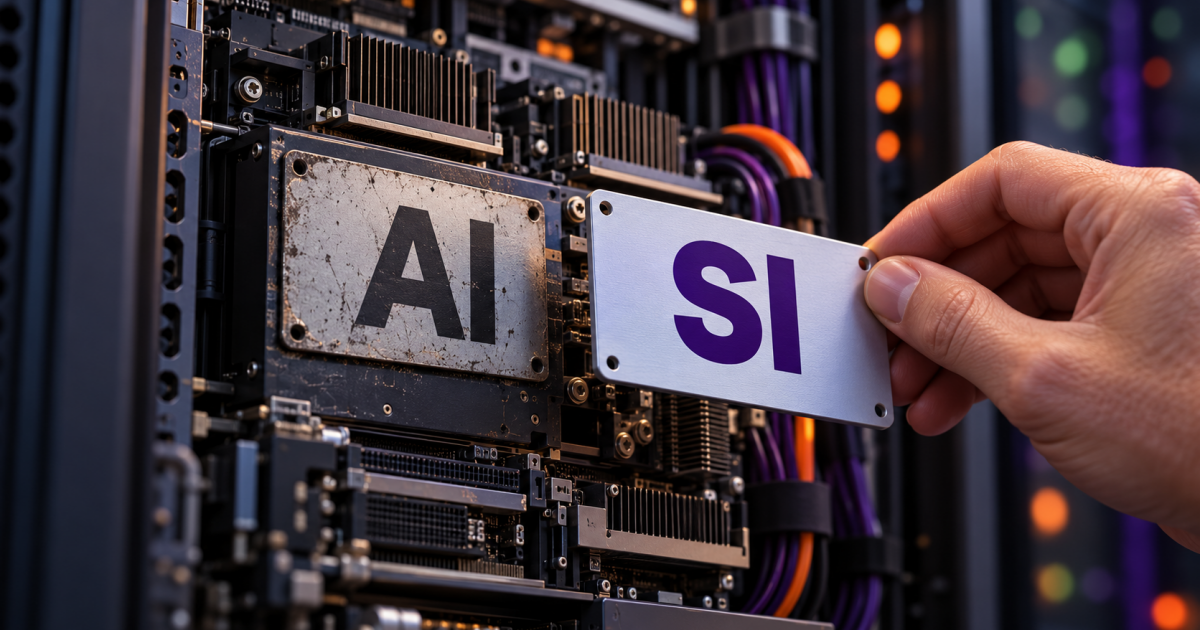
So, apparently, we’re calling it SI now.
At least the federal government is.
During a White House meeting with technology leaders the same day, the change became more than something buried in an executive order. When a reporter asked a question about an “AI agent,” the terminology was immediately corrected.
“It’s not AI. It’s SI.”
There is one particularly interesting detail in the executive order.
For now, Super Intelligence means the same thing Artificial Intelligence meant before the name changed.
The order uses the existing statutory definition of artificial intelligence as the definition of Super Intelligence. It also gives federal officials 60 days to propose legislative language that could modify, expand or supersede that definition.
In other words, we changed the name on Tuesday. We may refine what the new name means later.
I work in technology, so I can confirm this is not entirely unprecedented.
Names carry expectations
This would mostly be a funny terminology story if the words were interchangeable.
I’m not convinced they are.
Last month, we published a Perspective called “AI Is a Next-Word Predictor. That Does Not Make It a Parlor Trick.” The point was that describing how a language model works can make it sound much less impressive than what it is capable of doing.
Now we have gone rather dramatically in the other direction.
“Artificial Intelligence” already encourages people to think about these systems in human terms. We say they know things. We say they understand questions. We say they think, reason, remember, hallucinate and learn.
Sometimes those words are convenient shorthand. Sometimes they cause us to assume capabilities that are not really there.
Adding Super certainly doesn’t lower the expectations.
If I tell you a piece of software contains artificial intelligence, you may reasonably wonder what it can do. Tell you it contains Super Intelligence, and the name has already made a much bigger promise before the software does anything at all.
That can influence how businesses approach these systems, including how much authority they are willing to give them.
Tuesday’s AI woke up Wednesday as SI
Nothing happened overnight to the model itself.
A chatbot can still misunderstand a poorly worded question. A system can still produce a confident answer unsupported by its source material. An automation can still encounter an exception its designers never anticipated. Changing the acronym addresses none of those things.
The technology may be extraordinarily capable. We use these systems every day at Impartium, and we continue to find valuable ways to put them to work.
Calling one of them Super Intelligence doesn’t grant it additional capabilities any more than changing “database” to “Super Knowledge Vault” would make your customer records more accurate.
Although I admit Super Knowledge Vault has a certain ring to it.
The practical concern is what the new name encourages us to assume. Businesses still need to evaluate the technology according to what it can reliably do in a particular situation. “Super” can make that evaluation harder if people begin with a level of understanding, judgment or autonomy that the system has not demonstrated.
If you’re trying to separate what AI can genuinely do for your business from what the language surrounding it seems to promise, we can help work through it with you.
Talk through the possibilities →
“Superintelligence” already meant something
There is another wrinkle.
Superintelligence is not a brand-new phrase.
For years, discussions about the future of artificial intelligence have used artificial superintelligence, often abbreviated ASI, to describe a hypothetical form of AI with intellectual capabilities beyond those of humans. Current AI systems and artificial superintelligence have traditionally occupied very different places in that vocabulary.
Whether or when we reach that point is an entirely different conversation.
The terminology gave us a useful way to separate what exists today from a theoretical future level of capability. AI covers a broad category of current technologies. Artificial superintelligence has described something beyond them.
Using Super Intelligence as a replacement label for the whole category compresses those ideas together.
Your phone’s photo enhancement software can use AI. So can a recommendation engine, a language model, a manufacturing vision system and an autonomous software agent.
Under the new federal terminology, all of them can fall under Super Intelligence because the executive order currently defines SI by pointing directly back to the existing statutory definition of AI.
That may work as an administrative naming convention. Outside government documents, businesses still have to understand what they are actually buying, building or deploying.
Who gets to rename a global technology?
The executive order tells the U.S. executive branch what to call the technology. It does not establish the vocabulary for the rest of the world.
A federal agency may be required to call it SI. A software company can continue calling it AI. So can a university, a manufacturer, a developer, another country or the person sitting across the table from you in a meeting.
Artificial intelligence is a global field, and the terminology has been used for decades by researchers, governments, businesses and consumers around the world. A change inside the U.S. federal government does not automatically rewrite that vocabulary.
Its influence can extend beyond government, though. Federal terminology appears in policy, research, procurement, regulation and public communication. Companies do business with federal agencies. Researchers cite their work. Journalists report on it. Technology companies respond to it.
That gives SI plenty of opportunities to escape the documents where its use is required.
What happens after that comes down to usage. If companies, researchers, media and ordinary people start saying SI, it becomes part of the broader vocabulary. If they keep saying AI, SI may remain largely a federal convention.
Maybe six months from now we’ll all be talking about SI strategy, SI agents and SI-powered applications as though AI sounds hopelessly old-fashioned.
For now, the rest of us still have a vote, one acronym at a time.
We have renamed technology before
Technology has a long history of getting new labels.
Before we called it “the cloud,” companies were already hosting software, computing resources and data somewhere other than the physical building where their employees worked. That website you hosted somewhere in 1996 was in the cloud. It just didn’t have a name yet. The technology evolved enormously, but giving it a new name did not suddenly move the servers out of the office. “Cloud” gave us a convenient way to describe a model that was already developing.
“Interactive” had its moment too.
It distinguished websites, applications and other experiences that responded to what a person did from traditional media that simply sat there on the page. Eventually, “digital” swallowed most of it.
Today we can call almost anything digital, from a complex ecommerce platform connected to half a dozen business systems to a PDF version of a printed brochure. The broader label is easier, although it tells us less about what the experience actually does.
Then there are smartphones.
The first phones we eventually started calling “smartphones” did not become smarter the day we gave them the name. We needed language that distinguished them from the phones that mostly made calls, sent texts and played a surprisingly intense game of Snake.
The phones really did get smarter over time. Faster processors, better software, cameras, GPS, app ecosystems and internet connectivity dramatically expanded what they could do. The name had nothing to do with those technical advances, but it helped establish a new set of expectations.
Nobody buys a smartphone today and marvels that it can display a website. We expect it to navigate us across the country, recognize our face, take excellent photographs, stream a movie, make a payment and tell us whether we need an umbrella.
Over time, the technology earned more of the label while the label helped move the baseline for what consumers expected from the device.
Super Intelligence starts with that expectation problem on day one. The software did not acquire new capabilities when the terminology changed, while the word Super arrived with quite a few implications of its own.
The acronym doesn’t answer the important questions
A company evaluating one of these systems still needs some fairly ordinary questions answered.
What is the model actually being asked to do?
What information can it access?
How dependable does the output need to be?
When should a human review its work?
What happens when it is wrong?
Changing AI to SI doesn’t answer any of them, and a grander name may make them easier to overlook.
We have already seen enough useful AI to know that dismissing it as glorified autocomplete misses what is happening. At the same time, words such as “intelligence” encourage assumptions about understanding and judgment that deserve closer inspection.
Now we have added “Super.”
So if someone tells me they want to add Super Intelligence to their business, I’m going to start in exactly the same place:
What do you actually want it to do?
Once we know that, we can talk about the technology.
If AI, SI or whatever we end up calling it has made its way onto your company’s agenda, start with what you need it to accomplish and we’ll help figure out where the technology belongs.
Start with the business problem →